AI That Learns Your Community: Why Generic Bots Fail Builders | Jome
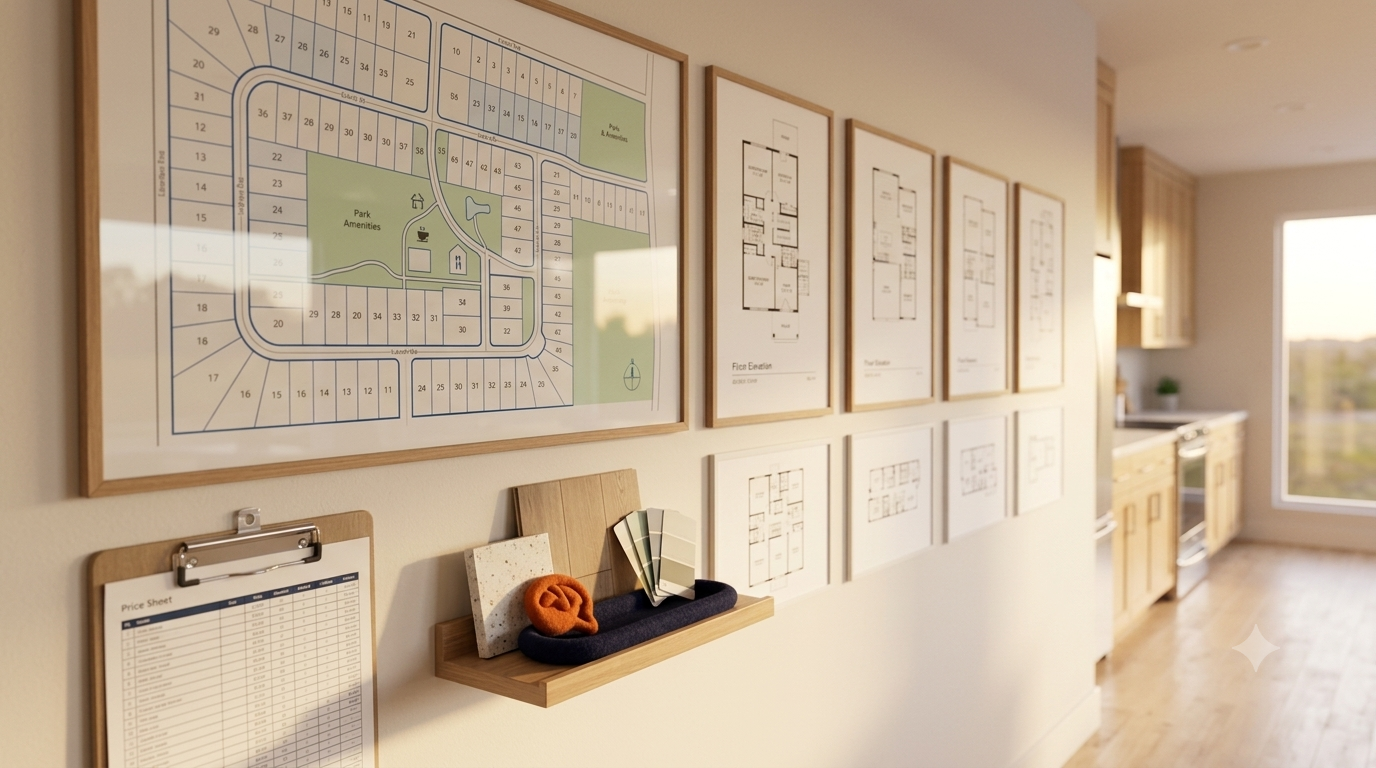
Cover image prompt
Photorealistic, wide aspect ratio. A model-home sales office wall covered in the specifics that make a community unique: a framed site map with lot numbers, a row of floor-plan elevations, a price sheet on a clipboard, a small shelf of finish samples (countertop chips, flooring swatches, paint cards). The detail should feel hyper-specific to one community, the opposite of generic. Warm directional light, neutral palette, shallow depth of field so one elevation drawing is in sharp focus and the rest softly recede. No people, no screens. Real and particular, not stock.
AI That Learns Your Community: Why Generic Bots Fail Home Builders
Ask a generic AI chatbot when your Saddle Creek community’s next quick move-in home will be ready, and it will give you a confident, friendly, completely made-up answer. It doesn’t know your communities. It doesn’t know that the Magnolia plan only comes single-story in two of your divisions, that your design center cutoff is two weeks after contract, or that buyers in this market always ask about the school zone before they ask about price — the kind of local-market specifics that NAHB consistently finds drive new-home buying decisions. It knows how to sound helpful. It doesn’t know your business.
That gap is the whole story of why most home builders who tried an off-the-shelf chatbot came away unimpressed. The technology worked. It just wasn’t trained on anything that mattered. As AI for home builder sales matures in 2026, the meaningful distinction is no longer “AI or no AI” — it’s “generic AI or AI that actually learned your sales operation.” This post defines the difference.
What “generic bot” actually means
A generic bot is built to handle any conversation for any business by pattern-matching on language. Drop it on your site and it can answer broad questions — “what’s a quick move-in home?” — in plausible general terms. What it can’t do is operate as if it works for you:
- It doesn’t know your specific communities, plans, lot inventory, or pricing, so it either deflects (“a team member will follow up”) or invents.
- It doesn’t know your business rules — financing partners, incentive structures, contract timelines, which plans are available where.
- It doesn’t know the buyer objections that actually come up in your markets, so it can’t handle them; it can only acknowledge them.
- It doesn’t know how your sales process works — when to book a tour, when to loop in the OSC, when to hand to the lender.
A generic bot is a receptionist who started this morning, has no notes, and is guessing. It can be polite. It can’t be useful at the moment of truth, which is when a real buyer asks a real, specific question and expects a real answer — and every time it punts that question to a human, it adds to the follow-up pile that’s already draining your CRM. For the broader definition of what AI in this category is and isn’t, see What “AI for Home Builder Sales” Actually Means in 2026.
What “AI that learns your community” means instead
The category that’s actually moving the needle is AI configured and trained on the specifics of one builder’s operation — sometimes one division or even one community at a time. Other verticals have already named this shift: dealership AI vendors talk about agents trained on the rules, hours, and voice of a specific rooftop rather than a generic off-the-shelf bot. The broader pattern — that AI delivers value when it’s grounded in a company’s own data and processes rather than deployed generically — is something McKinsey’s QuantumBlack AI research has documented across industries. The home building version is AI that knows:
Your inventory and plans. Which communities are open, which plans are available in each, what’s in quick-move-in inventory this week, and at what price. When a buyer asks “do you have a single-story under $500K near Round Rock,” it answers from your actual data, not from a template.
Your business rules. Your financing partners and incentive programs, your contract-to-close timeline, your design-center deadlines, your reservation process. The AI operates inside the constraints your OSCs operate inside.
Your buyers’ real objections. The questions and hesitations that recur in your markets — schools, commute, lot premiums, build timelines, rate buydowns — and how your team is positioned to handle each. The AI fields the objection instead of escalating it.
Your sales process. When to qualify, when to book a tour, when to hand off to a human OSC, when to bring in the lender. The AI follows your motion, not a default one.
The difference between these two things is not a feature. It’s the difference between a tool that demos well and a tool that produces booked appointments. We compare the build-vs-buy-vs-outsource versions of getting there in AI Voice Agent vs Inside Sales vs Call Center.
Why the “learns your community” part matters operationally
It’s tempting to treat this as a quality nuance — generic is fine, trained is nicer. It isn’t a nuance. It determines whether the AI can be trusted to talk to your buyers unsupervised, which is the only way it actually saves your team time.
A generic bot has to escalate constantly, because it can’t safely answer anything specific. Every escalation lands back on the OSC, so the bot adds a layer without removing work — it’s a slower front door to the same overloaded human. An AI that knows your communities, rules, and objections can carry a real conversation to a real next step on its own, only involving the OSC when a human genuinely adds value. That’s the difference between a tool that creates work and one that removes it.
It also matters for trust. Builders are rightly cautious about letting AI talk to buyers about a six-figure purchase. The thing that makes that safe isn’t turning the AI off — it’s training it tightly on your real information and rules so it stays on-script and on-brand, and routes anything outside its lane to a person. Specificity is what makes autonomy safe. That principle — AI on the repeatable work, humans on the judgment calls — is the same one we argue in Will AI Replace Your OSC?.
What to demand when you evaluate AI for your sales team
If you’re assessing AI for home builder sales, the questions that separate generic from trained are concrete. Ask any vendor:
- Does it know my actual inventory and pricing, kept current? Or does it answer plan and price questions generically?
- Can I encode my business rules — financing partners, timelines, incentives, which plans are where?
- How does it handle my market’s specific objections? Can I train it on the questions my OSCs actually get?
- What does it do when it doesn’t know? A good answer is “routes to a human cleanly.” A bad answer is “answers anyway.”
- Does it follow my sales process, including when to book a tour and when to hand to the OSC?
If the answers are vague, you’re looking at a generic bot with a home-builder logo on it.
Where Jome sits
Jome is built as the trained-on-your-operation kind, not the generic kind — and it does its work where the volume actually is: the follow-up grind. Your team closes; we handle the calling, texting, and qualifying of new and aged leads, working from your communities, your plans, your inventory, and the objections your OSCs hear every day. It books the buyers who are ready into your team’s calendar and routes the judgment calls to a human. The point isn’t a clever chatbot on your homepage. It’s an outbound and follow-up engine that knows enough about your business to be trusted with your buyers and to take real work off your OSCs’ plates.
FAQ
Isn’t every AI tool “trained” now? Most are trained to sound fluent in general. Fewer are configured on a specific builder’s inventory, rules, and objections. “Trained on language” and “trained on your business” are different claims — ask which one the vendor means.
How long does it take to train an AI on our communities? The heavy lift is gathering your real information — plans, pricing, rules, common objections — in one place. Once that exists, configuration is fast. The work is mostly about your data being accurate and current, not about the AI.
What happens when our inventory or pricing changes? That’s exactly why the “learns your community” model has to stay connected to live data. A trained AI that’s working from last quarter’s price sheet is just a confident generic bot. Currency of information is part of the requirement, not an afterthought.
Can a generic bot be good enough for top-of-funnel? For the broadest FAQ answering, maybe. But the moment a real buyer asks a specific question — and they always do — a generic bot either guesses or punts to your already-overloaded OSC. The value is in the specific moments, and that’s where generic fails.
The line that matters in 2026
The home builders getting value from AI aren’t the ones who bought the flashiest chatbot. They’re the ones who understood that an AI is only as useful as what it knows about their actual business — their communities, their plans, their rules, their buyers’ real questions. Generic AI demos well and disappears. AI that learns your community books tours.
If you want to see what an AI that actually knows your communities and plans sounds like talking to a buyer, book a 20-minute walkthrough with Jome. Bring one community’s plan and price details and we’ll show you the difference between generic and trained.
See an AI trained on your communities, pricing, and brand voice at ai.jome.com.