What "AI for Home Builder Sales" Actually Means in 2026 | Jome
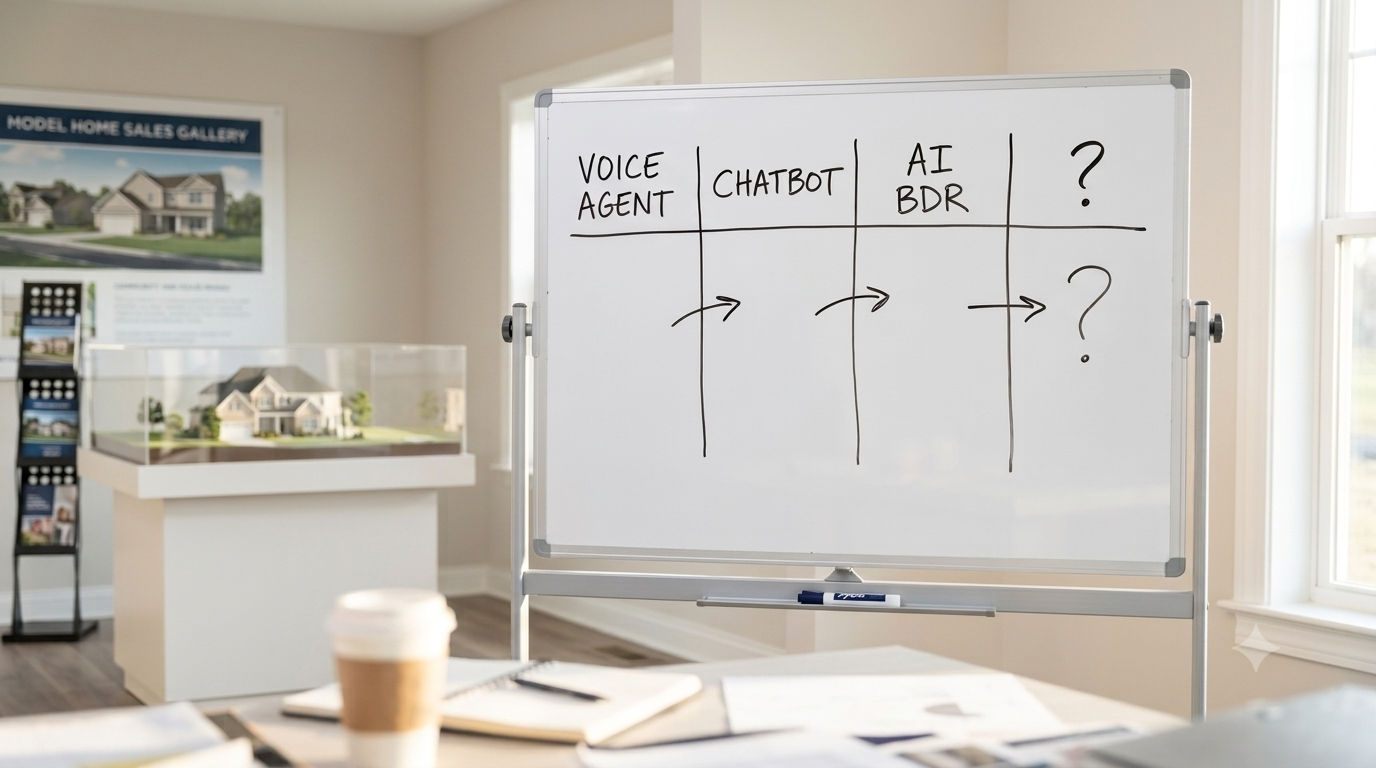
If you’ve sat through any sales technology pitch in the last twelve months, you’ve heard the phrase “AI for home builders” five different ways. One vendor showed you a chatbot. The next vendor showed you a voice agent. The third vendor showed you a CRM with an “AI summary” button. The fourth vendor showed you what they called an “AI BDR” but couldn’t explain what made it different from the second vendor.
This post sorts it out. We’ll define what each category actually is, what it does in a builder sales workflow, and what to ask in a demo so you know what you’re really buying.
There are four categories of AI worth knowing in home builder sales right now: chatbots, content tools, voice agents, and AI BDRs. Most builder sales teams will eventually have some version of each — but they solve different problems, and confusing them is how vendor evaluations go sideways.
Category 1: The chatbot on your website
The first AI you ever encountered in home builder sales was almost certainly a chatbot. A box pops up on the bottom right of the community page, the buyer types in a question, and the bot answers — or more often, asks the buyer to leave their name and number.
Modern chatbots are better than they were three years ago. They can answer questions about base prices, lot availability, move-in timing, and HOA fees if they’re connected to the right data. The good ones hand off to a human OSC in under a minute when the conversation gets specific.
What a chatbot is for: Capturing on-site inquiries that would otherwise bounce. Answering low-stakes questions (“What’s the HOA?”) so OSCs aren’t fielding them. Qualifying a buyer’s basic interests before the OSC follow-up.
What a chatbot is not for: Outbound follow-up. Calling buyers. Reactivating aged leads. A chatbot is a passive presence on a website. The buyer has to be on the page for the bot to do anything.
What to ask in a demo: “Does the bot proactively reach out to buyers who left the site without converting?” If the answer is “we send a follow-up email,” that’s not the bot doing it — that’s marketing automation. The chatbot stops working when the buyer closes the tab.
Category 2: Content and copy AI
The second category lives inside the marketing team, not the sales team. These are tools that draft listing copy, write community descriptions, generate variations of email subject lines, or build social posts about a new spec release.
The good ones save a marketing coordinator real hours per week. The honest answer is that almost any team in 2026 can get acceptable output from a general-purpose tool — the builder-specific ones add value mostly through templates and brand voice presets.
What content AI is for: Reducing the time marketing spends drafting copy. Making sure every spec home has a written description. Helping the team produce more channels of content than headcount would otherwise allow.
What content AI is not for: Anything in the sales cycle. The buyer never interacts with this category of AI. Content AI helps you market more efficiently; it does not help you sell more.
What to ask in a demo: “How does this connect to our sales workflow?” If the honest answer is “it doesn’t, it’s a content tool,” that’s fine — just don’t put it on the sales technology evaluation alongside the categories below.
Category 3: AI voice agents
This is the category that’s exploded in the last 18 months, and it’s the one most home builder sales leaders are still calibrating on. An AI voice agent is software that makes and answers actual phone calls in a natural voice. It dials buyers, has a real conversation, and either books a tour, answers a question, or — when the conversation needs a human — transfers to an OSC.
The category exists in multifamily property management (EliseAI), auto dealerships (Toma), restaurant scheduling, healthcare intake. Each of those verticals had the same problem builders have: too many inbound and outbound calls for the human team to handle, especially after hours.
A voice agent’s job is to be the front door of the phone line, plus the engine for outbound calling. It’s not trying to replace your OSC. It’s trying to make sure every buyer call gets answered and every follow-up call gets made.
What an AI voice agent is for: Answering inbound calls when the OSC is in a tour or off the clock. Making outbound calls to a buyer list at scale. Conducting basic qualification so the human OSC inherits a qualified buyer, not a cold one.
What an AI voice agent is not for: Doing the close. The agent’s job ends when the buyer is ready to talk to a person — that handoff is where your OSC team earns their commission.
What to ask in a demo: “Can I hear a real recording of one of your customers’ calls — not a demo script?” The difference between a good voice agent and a bad one is whether it sounds like the agent is following a flowchart or actually listening. You need to hear it on the phone, not see it in a slide.
Category 4: The AI BDR
This is the newest and most contested category. An “AI BDR” — Business Development Representative — is the layer that sits on top of a builder’s CRM and does the outbound follow-up work an inside sales team would do. It calls, texts, emails. It works leads on a cadence. It re-engages buyers who said “wait until next year.” It runs the long-tail follow-up that the OSC doesn’t have time for.
The category overlaps with voice agents — most AI BDRs use a voice agent as one of their channels — but the unit of work is different. A voice agent’s unit of work is the call. An AI BDR’s unit of work is the buyer relationship over weeks and months: multiple channels, multiple touches, escalation to a human OSC when the buyer is ready.
At Jome we’re in this category. Our positioning is the same one Dan and Sofia have been saying on sales calls since 2024: your team closes, we handle the follow-up grind. The system calls and texts old CRM leads, qualifies the ones who are ready, and books them onto an OSC’s calendar. We work alongside your OSCs, not instead of them — they’re still the only ones writing contracts. (For the side-by-side options, see AI Voice Agent vs Inside Sales BDR vs Outsourced Call Center.)
What an AI BDR is for: Reactivating aged leads at volume. Working buyers across multiple touches over time. Sitting between marketing’s lead handoff and the OSC’s appointment book. (Most of the failure modes we wrote about in 7 Aged-Lead Mistakes Builder Sales Teams Make are the failures an AI BDR is purpose-built to fix.)
What an AI BDR is not for: Closing. Site visits. Anything that requires a person walking a buyer through a model.
What to ask in a demo: “What’s the appointment conversion rate on aged-lead reactivation, measured at one of your real builder customers?” The number that matters is not how many calls the system makes; it’s how many appointments end up on the OSC’s calendar.
How the categories actually fit together
A complete 2026 builder sales stack uses three of these together. The chatbot catches website visitors. The voice agent (often inside the AI BDR) answers inbound calls and makes outbound ones. The AI BDR owns the workflow across channels and across time.
The piece nobody automates is the close. The OSC, the OSM, the design center walkthrough, the contract — those stay human. They have to. Buyers spend the largest amount of money they will ever spend on the relationship with a human, and that’s how it should be.
The AI is the leverage that lets the human OSC spend their time where buyers actually want them — in the model, on the design center call, walking a fence line. The AI is the system that does the work the OSC doesn’t have time to do at the volume the database requires.
If you’re a builder sales leader trying to evaluate categories, the question to start with is not “which AI do I buy?” It’s “where is my OSC team underwater?” Once you’ve named that — too many inbound calls, too much aged-lead backlog, too few hours in the day for follow-up — the category that fits the gap will be obvious. (For a deeper look at right-sizing the human side of this, see The OSC Capacity Playbook, and for the broader market argument see The 2026 Adoption Gap.)
What’s coming next
Two things are about to change the picture for home builders specifically. First, the voice agents are getting better at sounding like the team. The 2025 versions sounded like a competent stranger. The 2026 versions sound like an OSC who’s been at the community for six months — they handle accents, they handle interruptions, they handle buyers who want to ramble.
Second, integrations are getting closer to “actually works.” For two years, vendors said “yes, we integrate with your CRM” and what they meant was “we can read from it.” The newer generation is writing back — updating lead status, adding notes, marking appointments — which is the difference between an AI that helps and an AI that creates more cleanup work.
The vendors who survive the next 18 months will be the ones whose product does what the demo shows on the customer’s actual data. That’s the bar.
FAQ
Do I need all four categories? Probably eventually. Today, most home builders get the highest leverage from category 4 (AI BDR) on top of category 3 (voice agent) for sales, plus category 1 (chatbot) on the website. Category 2 (content AI) sits in marketing.
Will AI replace my OSC team? No. AI takes the follow-up grind off the OSC’s plate so they can spend more time in the model with buyers who are ready to buy. The OSC role is the same; the job inside it gets better.
Can one tool do all four? A few claim to. None we’ve seen do all four equally well. Pick a tool that’s great at one job and let the others be tools that are great at theirs.
How do I know what we’re actually buying in a demo? Ask which of the four categories the product is. Real vendors answer in one sentence. Confused vendors give you a paragraph.
Where to start
If you’re a sales leader and your OSC team is drowning in follow-up, start with the AI BDR / voice agent layer. That’s where the unworked pipeline lives and where the math pays back fastest. If you want to see what that looks like for your specific community count and lead volume, book a Jome walkthrough and we’ll run the numbers with you.
See what AI for home builder sales actually looks like in practice at ai.jome.com.