Speed to Lead for Home Builders: The First-5-Minutes Playbook | Jome
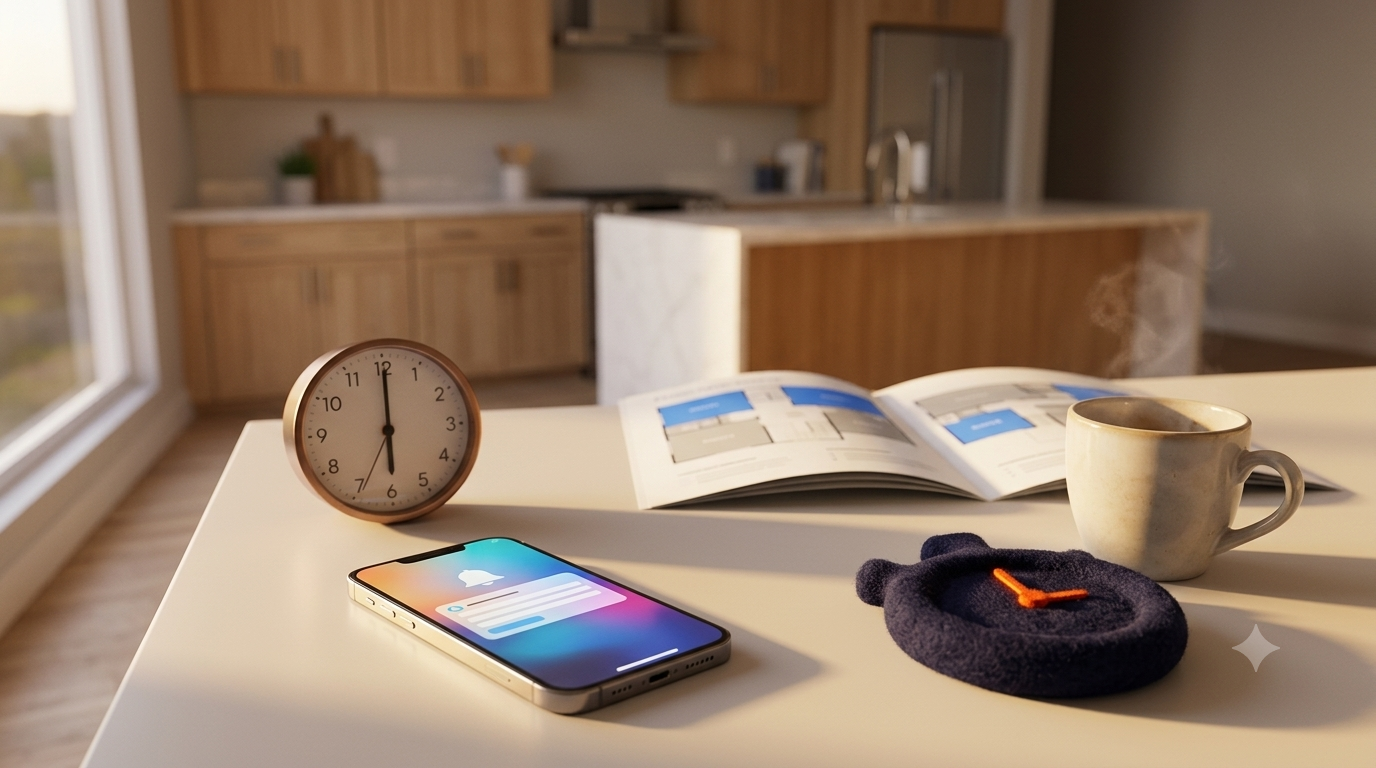
Cover image prompt
Photorealistic, wide aspect ratio. A close-up of an OSC’s desk inside a sunlit model home sales office at dusk — a phone screen lit up with a fresh inquiry notification, a small analog desk clock showing 6:52, and a half-finished cup of coffee going cold. The model home interior is softly out of focus behind: kitchen island, neutral cabinetry, a floor-plan brochure fanned open. The light is warm and golden, the end of a long day. No people in frame. Real, lived-in, not stock-photo. Mood: the quiet moment a lead arrives just as everyone’s about to leave.
Speed to Lead for Home Builders: The First-Five-Minutes Playbook
A buyer fills out the form on your community page at 6:52 on a Tuesday evening. They’ve just put the kids down, they’re scrolling on the couch, and for about fifteen minutes they are the most interested they will ever be in your floor plans. They want someone to call them back tonight.
By the time your OSC sees that inquiry at 9:15 the next morning, the buyer has filled out three more forms — two of them on competitors’ sites — and one of those competitors called back in ninety seconds. The race was over before your team clocked in.
This is the speed-to-lead problem, and home builders have it worse than almost anyone, because the purchase is enormous, the consideration window is long, and the inquiries arrive exactly when the sales office is closed. The good news: speed to lead is one of the few sales levers that’s fully within your control. You don’t need better leads to win it. You need a faster first five minutes.
Why five minutes is the number that matters
The classic research on this — Harvard Business Review’s study of online sales lead response — found that companies contacting a web lead within five minutes were dramatically more likely to qualify that lead than companies that waited even thirty minutes. The drop-off after the first hour is brutal, and it keeps falling from there.
The mechanism isn’t mysterious. Online buyers are in a research mindset, comparing several options at once. The first credible response anchors the relationship. Whoever calls first gets to frame the conversation, set the next step, and put a tour on the calendar before the buyer has talked to anyone else. Everyone who calls second is negotiating against an appointment that’s already booked.
For home builders, two things make this harder. First, the dollar value of a single new-home sale means a lost lead is expensive in a way a lost e-commerce cart never is. Second, more than half of new buyer inquiries arrive outside business hours — evenings, weekends, holidays — which, given how much of the buyer journey now starts online (NAHB tracks the shift in how new-home shoppers research), is precisely when a human OSC isn’t sitting at the desk. Your fastest competitor isn’t necessarily the one with the best reps. It’s the one whose response doesn’t depend on someone being awake.
The playbook: what the first five minutes should actually contain
Speed alone isn’t enough. A fast, generic “Thanks for your interest, an agent will reach out” autoresponder is fast and useless — it doesn’t move the buyer toward a tour. The first five minutes need to do real work. Here’s the sequence to install.
Minute 0–1: Acknowledge like a human, not a form
The first touch should reach the buyer on the channel they used, within sixty seconds, and it should sound like a person who read what they submitted. If the buyer asked about a single-story plan in a specific community, the acknowledgment references that community and that plan. “Got your note about the Magnolia plan at Saddle Creek — I can get you in to walk it. Are evenings or weekends better?” beats “Thank you for contacting us” every time.
Minute 1–3: Ask one qualifying question, not ten
The goal of the first contact is not to qualify the buyer to death. It’s to keep them talking. One well-chosen question — timeline, or financing readiness, or which community they’re focused on — keeps the conversation moving without feeling like an interrogation. Save the full discovery for the tour.
Minute 3–5: Offer a specific next step with specific times
Vague next steps (“someone will follow up”) kill momentum. The close of the first five minutes is a concrete tour offer with two or three real time slots. The buyer either picks one or tells you what’s wrong — and either answer is pipeline. The point of speed to lead is to convert interest into a calendar event before the interest cools.
Where home builder speed-to-lead breaks down
Most builders already know they should respond fast. The reason they don’t isn’t ignorance — it’s structure. Four failure points show up over and over.
Inquiries arrive after hours, and nobody’s covering them. This is the biggest one. Your CRM dutifully logs the 8pm lead and surfaces it the next morning, by which point the five-minute window closed eleven hours ago.
One OSC, one community, one set of hands. When a single OSC is running a community, every minute they spend chasing a fresh inquiry is a minute they’re not with a buyer who’s standing in the model right now. They can’t be in two places, so the new inquiry waits. We dig into the economics of this in The Understaffed OSC Problem.
The lead routing has friction. The inquiry comes into a marketing platform, gets synced to the CRM on a schedule, gets assigned by a rule, and finally pings an OSC — and the whole pipeline takes forty minutes before a human even knows the lead exists.
Follow-up depends on memory. Even when the first call happens fast, the second and third touches rely on an OSC remembering to make them. They don’t always remember, because they’re human and busy. This is one of several ways a builder CRM quietly drains — we catalogue the rest in 6 Signs Your Home Builder CRM Is Leaking Pipeline, and the aged-lead version specifically in 7 Aged-Lead Mistakes Home Builders Keep Making.
The fix: make instant response a property of the system, not the person
Here’s the uncomfortable truth: you cannot reliably hit a five-minute response window with human labor alone, because the leads don’t arrive on a human schedule. You can ask your OSCs to check their phones at night, but that’s not a humane policy and it won’t hold. The teams that win speed to lead in 2026 have stopped treating the first response as a thing a person does and started treating it as a thing the system does — automatically, instantly, every time, at 2am and on Sunday morning.
This is exactly the part Jome was built to handle. Your team closes; we handle the follow-up grind. When a new inquiry lands, Jome’s AI calls and texts the buyer within seconds — on the buyer’s channel, referencing what they asked about — qualifies lightly, and books the ready ones straight into an OSC’s calendar. The OSC walks in the next morning to appointments, not to a backlog of cold forms. The human does the part humans are great at, which is standing in the model home and helping a family fall in love with a house. The system does the part humans can’t, which is being awake and instant 24/7.
If you’re weighing this against hiring an after-hours BDC or an outsourced call center, our AI Voice Agent vs Inside Sales vs Call Center guide breaks down the trade-offs in detail.
How to measure whether your speed to lead is actually improving
Activity metrics lie. “Calls made” tells you the team is busy, not fast. Track these instead:
Median time to first contact, measured from inquiry timestamp to first real human-or-AI touch. Not average — median, so a few fast responses don’t hide a long tail of slow ones. Watch it separately for business hours and after hours; the after-hours number is usually where the bleeding is.
Speed-to-tour-booked, the time from inquiry to a confirmed appointment on the calendar. This is the metric that ties to revenue.
After-hours capture rate, the percentage of evening and weekend inquiries that get a response before the next business day. For most builders this number is the single biggest available improvement.
When you can show that after-hours inquiries now get a sub-five-minute response and that tour bookings from evening leads have climbed, the speed-to-lead conversation is over.
FAQ
What’s a good speed-to-lead time for home builders? Under five minutes for the first contact is the target the research supports. Realistically, most builders should aim to get the after-hours number — currently often “next morning” — down to minutes, because that’s where the easy wins are.
Isn’t an instant autoresponder enough? No. An autoresponder acknowledges the lead but doesn’t advance it. The first five minutes need to qualify lightly and offer a specific next step. A generic “we’ll be in touch” actually trains the buyer to wait, which is the opposite of what you want.
Won’t fast, automated outreach feel pushy? Only if it’s generic. A fast response that references the specific plan or community the buyer asked about reads as attentive, not aggressive. Speed plus relevance is the combination that works.
Can my CRM do this on its own? CRMs are good at capturing and storing leads. They’re generally not built to make an instant outbound call or text and hold a real conversation with a buyer who replies. That outbound layer usually has to sit on top of the CRM.
The first five minutes are a decision, not a department
Speed to lead isn’t a personality trait of your best OSC. It’s a property you can design into your sales operation — or fail to. The builders capturing the most pipeline from the same volume of leads aren’t running faster reps. They’ve simply made sure that no inquiry, at any hour, waits for a human to wake up before it gets a response.
If you want to see what a guaranteed five-minute response looks like across every inquiry your communities generate — including the ones that arrive at midnight — book a 20-minute walkthrough with Jome. We’ll look at your current response times by hour of day and show you where the booked tours are hiding.
Guarantee a five-minute response on every inquiry, day or night — see how at ai.jome.com.