Outsourced Call Centers vs AI for Builder Sales | Jome
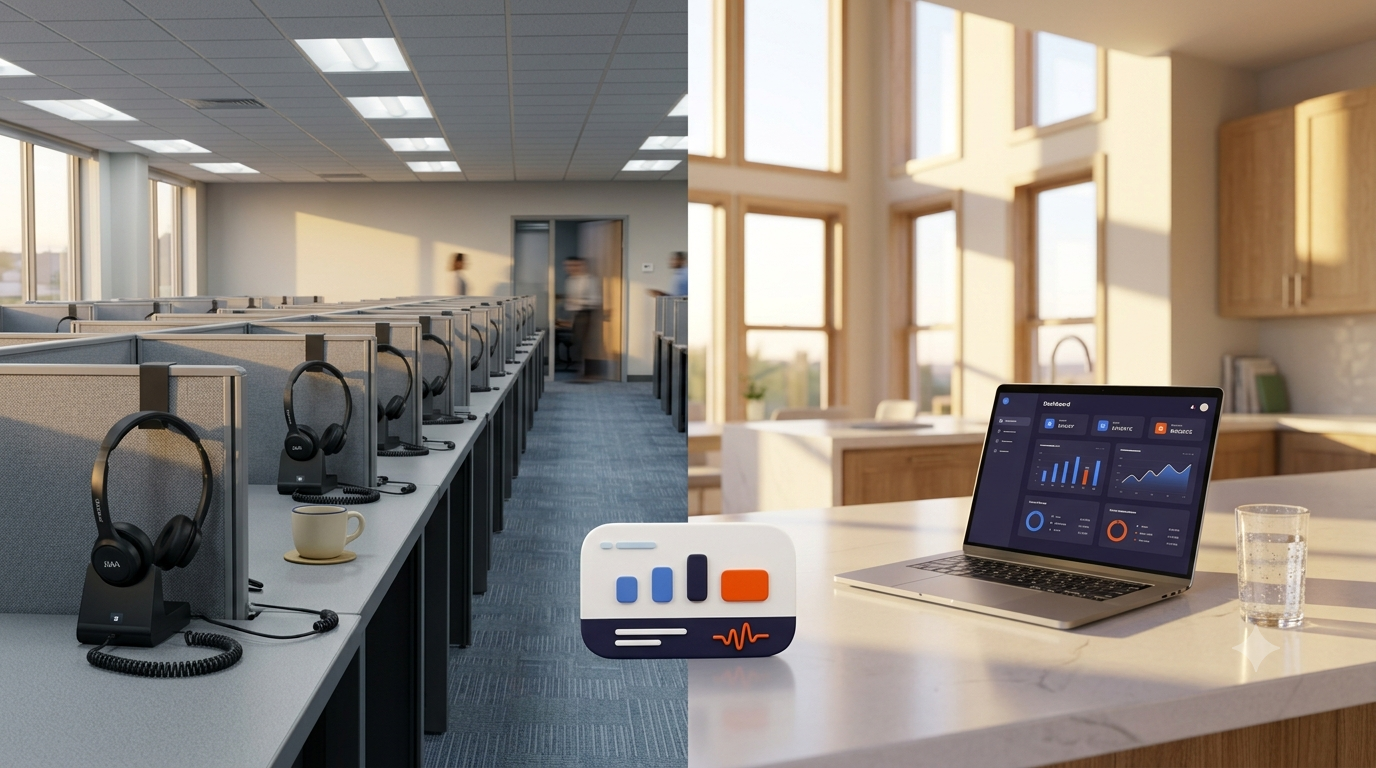
The math behind outsourced call centers used to be simple: hire a BDC, pay $4-9 per qualified contact, get tours on the calendar, scale up or down with the volume. For a decade, that was the only way to add sales capacity to a builder division without hiring full-time OSCs.
The math has changed. AI sales extensions now do most of what an outsourced BDC does, at a different cost structure, with a different quality profile, and — the part most builders haven't priced — a different impact on your CRM data and your OSC team.
This post is the side-by-side. We're not going to tell you outsourced call centers are dead — they aren't, and there are scenarios where they still win. We're going to walk through the actual cost math, the quality differences, and the question most builder execs haven't asked: what does each option do to my CRM?
TL;DR — the comparison in one paragraph
An outsourced call center typically charges $4-9 per qualified contact, $25-50 per booked appointment, with monthly minimums starting around $4,000-7,500 per division. An AI sales extension typically prices flat-rate per lead bucket — $6,000-16,000 for a multi-thousand-lead pilot — with no per-contact charge. The volume threshold where AI becomes cheaper per contact is usually around 1,500-2,000 attempted contacts per month. Below that, an outsourced call center may still pencil. Above that, AI usually wins on cost AND on data quality. Quality is similar on first-touch contact rate; AI wins on consistency and CRM write-back, humans win on edge cases and rapport.
The five questions that decide which model fits
Before the cost math, the fit math. Five questions tell you which option is right for your division.
1. How many leads are you trying to work per month?Outsourced BDCs are priced per contact. The unit economics work when volume is moderate (a few hundred attempts a month). They get expensive fast above 2,000 attempts.
2. How aged is your CRM?A BDC typically works the most recent inquiries. The 18-month-old aged-lead pile usually never gets touched because the rep economics don't work (low contact rate × per-contact pricing = bad margin for the BDC).
3. What kind of conversation does the lead need?A first-touch qualification call is the same script for any builder. A buyer who wants to discuss design center upgrades, lot premiums, or floorplan options needs a builder-specific conversation that most BDC reps can't have.
4. How clean is your CRM?A BDC adds notes when the rep remembers to. AI writes structured notes after every interaction. If your CRM hygiene is already a problem, that gap matters.
5. What's your time-to-coverage tolerance?Standing up an outsourced BDC team takes 2-6 weeks (training, integration, ramp). Standing up an AI extension is 24-72 hours of integration and a few days of script tuning. If the gap is "we need coverage starting next month," AI is faster.
Cost math — outsourced call centers
Most outsourced BDCs serving home builders price one of three ways:
Per-qualified-contact: $4-9 per contact reached, plus a monthly minimum. A "qualified contact" usually means a 60+ second conversation with the lead. Voicemails and bad numbers don't count.
Per-booked-appointment: $25-50 per appointment scheduled into the OSC's calendar. Higher per-event cost, but only pays on outcome.
Hybrid hourly: $25-45 per rep-hour, with a minimum hours commitment. Used by larger BDCs with more flexibility.
A typical mid-sized division running 300 new leads a month plus a goal of working 500 aged leads might pay:
- $4,500-7,000 monthly minimum
- ~$1,800-4,500 in per-contact charges if contact rates are 30-60%
- ~$700-1,500 in per-appointment charges if booking rates are 5-10%
All-in: $7,000-13,000 a month for a single division working ~800 leads/month.
What you get: trained human reps, English-speaking (usually), some industry training, scripts you can review. After-hours coverage is usually limited or extra; weekend coverage similarly extra.
What you usually don't get: consistent CRM data hygiene, deep training on your specific communities, willingness to work the 18-month-old lead bucket, or a long-tail follow-up cadence (because the per-contact economics don't work on low-yield buckets).
Cost math — AI sales extension
AI sales extensions usually price per lead bucket, flat rate, monthly. There's no per-contact charge — the AI runs the bucket against a defined cadence and reports outcomes.
A typical builder pilot might price:
- 2,000-5,000 lead bucket: $6,000-10,000 one-time pilot fee
- 5,000-10,000 lead bucket: $11,000-15,000
- 10,000-20,000 lead bucket: $16,000-22,000
(For reference, Jome's pilot pricing structure is in our deck, discussed in sales conversations rather than published; ranges above reflect what's typical in the category.)
The AI is running every channel — voice, SMS, email, voicemail — across the entire bucket. There's no "qualified contact" line item; the system just keeps working.
What you get: 24/7 coverage, consistent script execution, structured CRM write-back, no fatigue, no turnover, no attrition mid-pilot. Buyers get a fair shot regardless of how old the lead is.
What you don't get (today): the warm rapport a great human BDC rep can build, the ability to handle truly edge-case conversations, and the political comfort of "we have a team of humans on this."
Quality math — first-touch contact rate
Both models are surprisingly close on the metric most builders care about: did we reach the buyer.
Industry benchmarks (Bokka Group, Do You Convert) put outsourced BDC first-touch contact rates at 25-45% on aged leads, depending on data quality. AI sales extensions running multi-channel cadences run 50-85% — voice attempts plus SMS plus email beats voice-only attempts on contact rate, basically every time.
In one Arizona pilot, an AI sales extension hit an 82% contact rate on a 2,845-lead bucket aged 4-18 months. That's the upper end of what's possible with a strong cadence on a mid-quality lead bucket. Your numbers will vary — but the floor is usually higher than what an outsourced human team produces on the same bucket.
Quality math — the conversation itself
This is where the comparison gets honest.
A great human BDC rep can build rapport, read tone, and recover from a buyer who's annoyed at being called. AI is improving here fast, and modern voice AI (like the systems running on builder pilots in 2026) is unrecognizable from the chatbots of 2022. But on the long tail — a buyer with an unusual situation, a tough objection, or an emotional response — humans still win.
The good news: that's not the bulk of the conversations. Most first-touch builder calls are pattern-recognition: short qualification, intent check, schedule the next step. AI handles those at parity. The 5-10% of conversations that need real rapport, the AI books for the OSC.
For the question of "does the AI sound robotic," the short answer is no — modern voice AI sounds like a real person, and most buyers don't realize it isn't. We've written about whether AI voice still sounds robotic in new home sales in more depth; the punchline is that the 2026 generation is good enough that conversation quality isn't the bottleneck.
CRM data — the hidden cost difference
This is where most builder execs haven't thought hard enough.
An outsourced BDC writes notes when the rep is trained to. The notes are inconsistent in format, often lack intent tags, and rarely surface objections in a way you can coach against. The CRM ends up with a lot of "talked to buyer, follow up next week" entries.
An AI sales extension writes structured notes after every interaction — buyer intent (browsing / qualified / hot), stage (research / financing / ready to tour), objections raised, next-action recommendation, full transcript link. Every conversation, every time.
Six months in, the difference is visible: one CRM is fuller and a little messier. The other is genuinely cleaner than it was before the program started, with intent tags that let you actually do funnel analysis. That's a real ROI line that most builders don't model in the original cost comparison.
If you want to see the framework for evaluating which AI vendor produces which write-back quality, our buyer's framework for AI in home builder sales walks through the full vendor evaluation in detail.
When outsourced call centers still win
Three scenarios:
1. You need a small program, fast. A BDC can ramp 100-300 leads a week with a 2-week setup. AI can do the same in 24 hours, but if you don't have the lead volume to justify the AI minimum, the BDC is more proportional to your spend.
2. The leads need a custom human script and a builder-trained rep. Some custom builder operations (high-end estate, complex financing) deserve a human first touch. AI can still do follow-up; the BDC handles the conversation.
3. Political reality. Some sales VPs will not approve an AI program for first-touch contact regardless of the math. A BDC fills the gap while the AI does aged-lead reactivation. Both run side by side. (NAHB workforce research is a useful reference for staffing decisions if internal stakeholders need outside data.)
When AI wins
Pretty much everywhere else above ~1,500 attempted contacts per month: cost-per-contact is lower, contact rates are higher, CRM data is cleaner, and after-hours coverage is built in.
The bottleneck for most builders isn't tooling; it's hours. A system like Jome runs 24/7 against the leads your team can't get to — peak-hour calls at 9 AM, 12 PM, and 5 PM, then text and email follow-up overnight — without asking your OSCs to change their day. Adoption isn't a question of whether your OSCs learn a new tool; it's a question of how much of the grind work they no longer have to do.
Common mistakes in the comparison
Mistake 1 — comparing AI to "your in-house OSC team" instead of to the outsourced BDC you're considering.This is the wrong comparison. AI doesn't replace your OSC; it replaces the next outsourced rep you would have hired.
Mistake 2 — pricing AI like enterprise software.AI sales extensions typically price as month-to-month engagements with clear out clauses. If a vendor wants seven figures up front, they're not pricing for a builder sales op.
Mistake 3 — not measuring CRM data quality before/after.Run a baseline before either program starts. The difference at 90 days is real and most builders never measure it.
Mistake 4 — assuming the BDC can work your aged leads.Per-contact pricing means the BDC's incentive is to work the easiest leads first. Your 18-month-old buyer is the last one they'll dial.
FAQ
Can we run both at the same time?Yes — and it's a common pattern. AI runs the high-volume aged-lead bucket and overnight cadence; the BDC handles a smaller, custom-script segment. The two coexist if you split the lead populations clearly.
What about hiring more in-house OSCs instead of either?A great in-house OSC handles 200-250 leads/month and costs ~$60-90K all-in. Above 1,000 leads/month of work, you're hiring three OSCs. Above 5,000, you've built a contact center. The math usually favors AI for the aged-lead and overnight coverage even with strong in-house OSC teams. See how many leads one OSC can actually handle for the capacity math.
How do we measure quality differences?Three metrics: first-touch contact rate, appointment-set rate, and contract-conversion rate. Run both options against a matched lead bucket for 30 days and compare.
Is AI more compliant or less compliant than a BDC for TCPA purposes?Roughly equivalent in practice — both rely on consent capture at lead source, both must respect quiet hours and opt-outs, both should log every contact attempt. AI tends to have cleaner audit logs by default.
What to do on Monday morning
Pull last quarter's invoice from your outsourced BDC (if you use one) or last quarter's contact-center hourly bill. Divide by total qualified contacts. That's your real cost-per-contact today. Then ask a vendor in the AI category for a fixed-fee quote on the same lead volume. The difference will be either small enough that you keep what you have, or big enough that you should pilot — and the answer will arrive in one Monday morning, not one quarter.
Run the cost math on your own pipeline — see Jome's fixed-fee model at ai.jome.com.
Next reads
- How to Evaluate AI for Home Builder Sales — the buyer's framework behind the cost comparison
- How Many Leads Can One OSC Really Handle? — the capacity math behind the staffing decision