7 Aged-Lead Mistakes Home Builders Keep Making | Jome
Cover image prompt
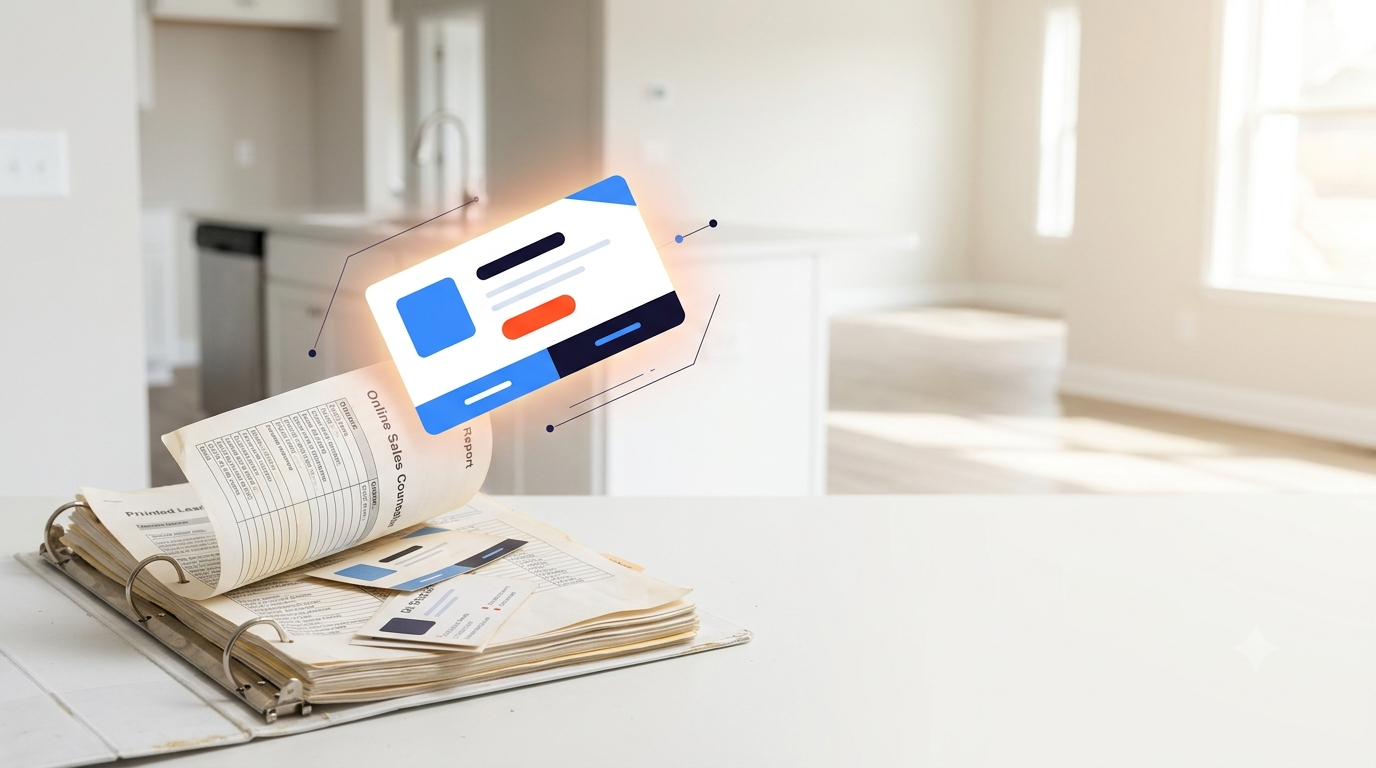
Photorealistic, wide aspect ratio. A worn leather binder sitting on the corner of an OSC’s desk inside a model home. The binder is bursting with old contact cards and printed lead reports; some of the cards are dated months ago, edges yellowed. Sunlight comes in from a window on the right, lighting dust in the air. Out-of-focus background shows the model home interior — kitchen island, neutral paint, framed marketing brochure. Mood: nostalgic and slightly guilty, like the binder is a confession. No people in frame. Real, not stock-photo. Color palette neutral and warm.
7 Aged-Lead Mistakes Home Builders Keep Making (And the Fix for Each One)
Every home builder sales team I’ve talked to has the same drawer. Sometimes it’s a literal drawer; more often it’s a CRM tag or a saved view called “Old Leads” or “2024” or “Cold.” Whatever you call it, it’s where buyer inquiries go when the OSC is too busy to keep calling, the lender said the credit wasn’t ready, or the buyer said “later this year” and “later this year” got here.
The drawer is the most expensive thing in your sales org. You already paid Google to put those inquiries in there. You already paid the OSC for the first three calls. You already trained the buyer to know your community, your floor plans, your price range. And then the drawer.
Here are the seven mistakes I see most often, and what to do about each one this quarter. None of them are about lead quality. They’re all about the system around the lead.
1. You treat aged leads as a separate database, not a separate workflow
The first mistake is structural. The team takes “old leads” and dumps them into a separate list, a separate view, a separate marketing automation. They are now in a different universe from the leads the OSC actually works.
The OSC is paid on this week’s appointments. The OSC opens the CRM and works the new leads. Aged leads exist somewhere in a sales manager’s nightly report, but nobody owns the daily action.
Fix: Keep one queue. Aged leads should appear in the OSC’s regular workflow alongside new leads, with a different priority and a different cadence — not a different system. The minute aged leads live in a separate tool, they live in nobody’s day.
2. You restart the conversation instead of continuing it
The OSC pulls up a six-month-old lead, sees the lead’s last note (“Wants to wait until Q3”), and texts something like “Hi Sarah, just checking in to see if you’re still interested in new construction.” That message reads like a stranger.
The buyer has already had a conversation with your community. They toured the model. They walked through three floor plans. They emailed twice about the elementary school zone. The follow-up needs to pick up the thread, not start over.
Fix: Every aged-lead touch must reference the specific thing the buyer cared about. If they asked about the school zone, the next message is about the school zone. If they wanted a single-story with a study, the next message is about new single-story spec releases. Treat the prior conversation as the briefing for the next one.
3. You wait for “a reason to reach out”
OSC teams routinely tell me they don’t follow up on aged leads because “I don’t have a reason.” The implicit assumption is that the buyer needs a trigger — a new model release, a rate drop, a community grand opening — to justify the call.
That’s a polite excuse. Most of the time the buyer has just moved on with their life and is waiting for someone to remind them why they got interested in the first place. The trigger doesn’t have to be new. It can be a question.
Fix: Build a question-based outreach cadence. “What changed since we last spoke?” is more useful than another new-spec announcement. The first message that gets a reply wins the relationship back. Listicles like our What ‘AI for Home Builder Sales’ Actually Means in 2026 post go deeper into the right cadence shapes — but for aged leads specifically, the prompt is “what changed,” not “we have news.”
4. The follow-up only happens during work hours
Half of new buyer inquiries arrive after 6pm. Aged-lead follow-up is even worse — the OSC is calling people who have day jobs, kids, and a school pickup, and the only call attempts happen between 10am and 4pm.
You can hear it in the data: the answer rates on aged-lead outreach during business hours are routinely under 20%. The same numbers, called at 7:15pm or on Saturday morning, perform meaningfully better.
Fix: Move aged-lead outreach to the time of day the buyer is actually free. That usually means evenings and weekends. If your OSC team can’t cover those hours sustainably — and most can’t, because that’s not a humane schedule — that’s the cue to put a system underneath them. Which brings us to the next mistake.
5. You expect a human OSC to do the volume math
A community OSC who’s been with you a year has 2,000 to 4,000 aged inquiries in their CRM. To work that backlog at a healthy three-touch cadence, they’d need to make 6,000 to 12,000 contact attempts. Their week has 40 hours.
The math has never worked. Builders solve it by quietly accepting that aged leads will rot, and then by buying more new leads at higher CPLs to refill the top of the funnel.
Fix: The OSC is not the right resource for the volume. They are the right resource for the close. The follow-up grind — the third call, the fifth text, the “are you still in market” check-in — is exactly the kind of work that benefits from automation. At Jome we built the system that does this part — your team closes, we handle the follow-up grind, calling and texting old CRM leads until the ones who are ready raise their hand and get booked into an OSC appointment. Builders using us on aged backlogs typically pull live, interested buyers out of CRMs that hadn’t been touched in months. (For a deeper comparison of options, see AI Voice Agent vs Inside Sales BDR vs Outsourced Call Center.)
6. You measure aged-lead work by activity, not by appointments
When sales managers do try to push aged-lead work, the metric is “calls per week” or “texts sent.” That’s a productivity metric, not a sales metric. It rewards going through the motions and tells you nothing about whether the work generated pipeline.
The right metric is buyer appointments booked from aged leads. Anything else and you’re just measuring how busy the team looks.
Fix: Add an appointments-from-aged-leads line to the weekly sales report. Track it next to appointments-from-new-leads. The first time a community shows 30% of monthly appointments coming from aged-lead reactivation, the conversation about whether this is worth doing ends.
7. You don’t have a recycle path for “not now”
A buyer who says “we’re going to wait until next year” is not a no. They’re a yes with a date. Most builder CRMs treat that buyer the same as a hard pass — disqualified, archived, gone from the OSC’s day.
The miss is enormous. Twelve months later, that buyer is in the market again, and they’re not getting a call from you. They’re getting Zillow alerts and a postcard from your competitor.
Fix: Build a “future buyer” recycle path. Tag buyers with their stated decision window, and re-engage them 60 days before that window opens. The cadence is light — one well-timed message can do it — but it has to actually happen, automatically, without an OSC remembering.
The pattern under all seven
Look at the seven mistakes together and they all rhyme. The issue isn’t that home builders don’t know what to do with aged leads. The issue is that the system around the OSC isn’t built to do it at the volume the database requires.
That’s a capacity problem, not a discipline problem. You can fix discipline with training. You can only fix capacity by adding capacity — either hiring more humans, which most builders won’t do, or putting a system underneath the team that does the follow-up grind for them.
The builders pulling the most pipeline out of aged backlogs in 2026 are not the ones with the best-trained OSCs. They’re the ones who stopped expecting a single OSC to be a system.
FAQ
How old is “aged”? For most home builders, anything older than 30 days without a buyer-initiated touch is functionally aged. The OSC has moved on to fresher inquiries, and the lead is sitting unworked.
Won’t aggressive aged-lead outreach annoy buyers? Only if the outreach is bad. Generic “checking in” messages annoy people. Specific, timed, conversational outreach about the thing the buyer cared about does not. The complaint volume from well-built aged-lead reactivation is lower than most teams expect.
What’s a realistic conversion rate on aged leads? A clean aged-lead reactivation effort on a builder CRM typically pulls 1-3% of dormant inquiries into a booked appointment over 30-60 days. That sounds small until you do the math against a CRM with thousands of cold contacts.
Can my existing CRM handle this? Most builder CRMs are built for capturing leads, not for re-engaging them at scale. You can build the workflow in your CRM, but the actual outbound — the calls, the texts, the responses to buyer replies — usually has to live outside the CRM or in a layer on top of it.
Stop letting the drawer rot
The aged-lead drawer is the single biggest piece of unworked pipeline in most builder sales orgs. Fixing it isn’t a software project; it’s a decision to stop treating the OSC as the only labor available.
If you want to see what reactivating a builder CRM at scale actually looks like — and the appointment volume it produces — book a 20-minute walkthrough with Jome. We’ll look at your aged-lead numbers and tell you what the math says you could pull out this quarter.
Stop losing your dead pile to these mistakes — see how Jome reactivates aged leads at ai.jome.com.