OSC-to-OSM Handoff Playbook | Jome
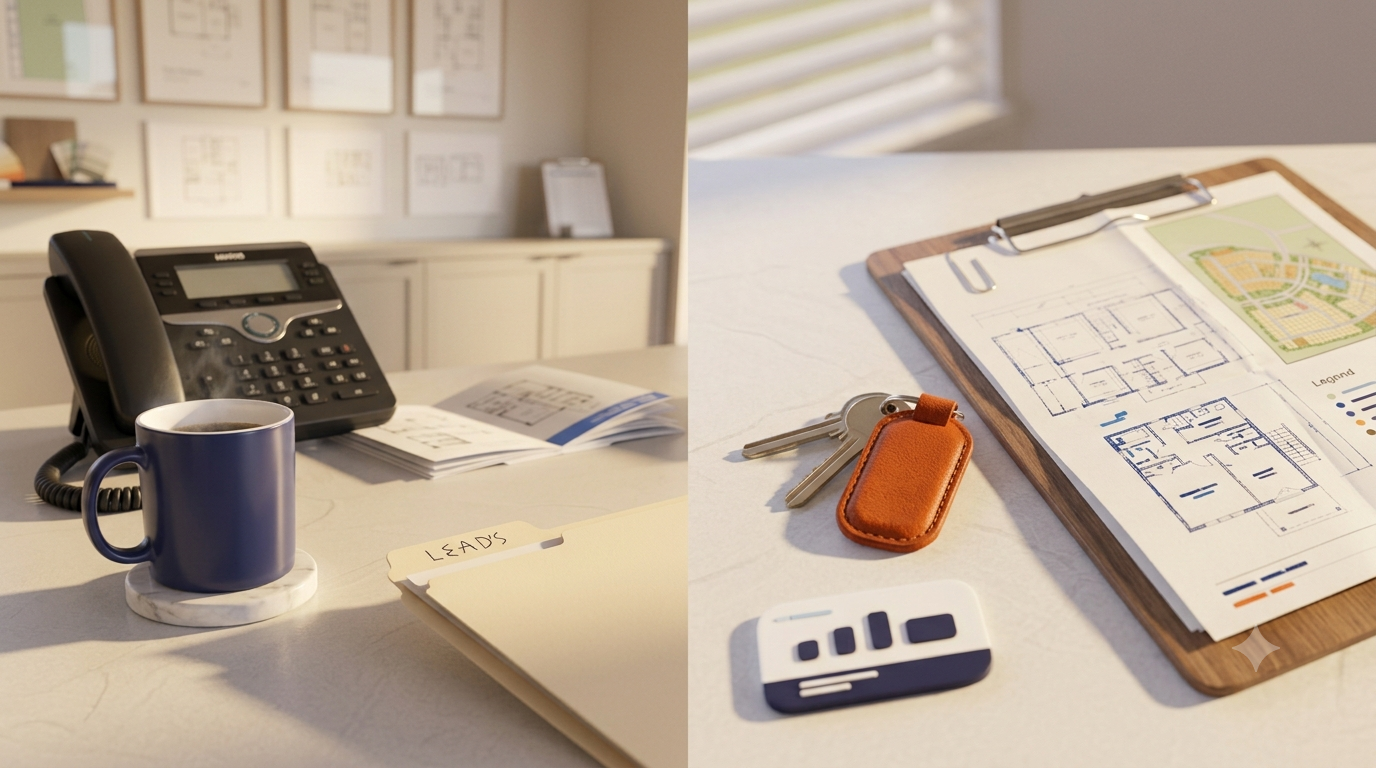
The buyer was warm. The OSC ran a great qualification call — budget aligned, timeline real, two communities narrowed down, financing pre-approved. She booked the tour for 11 AM Saturday at the Cedar Park sales center.
Saturday morning, the buyer walks in. The OSM greets her, walks her through the model, and asks if she's been pre-approved for financing. The buyer's face changes. "I told the woman on the phone all of that on Wednesday."
This isn't a one-off. The OSC-to-OSM handoff is one of the quietest pipeline leaks in builder sales, and it's almost always invisible until a customer survey or a deal review surfaces the breakdown. The buyer doesn't tell you when the handoff fails — they just don't write the contract.
This post is the handoff playbook. What context has to travel, how it travels, what the OSM does with it, and the three patterns that keep buyers from feeling like they're starting over.
TL;DR — the handoff in one paragraph
A clean OSC-to-OSM handoff transfers four things: buyer identity, qualification context, conversation history, and the next-action expectation. It happens at least 24 hours before the tour (so the OSM can read), it lives in the same CRM the OSC is already using, and it gets reviewed by the OSM in the morning before the tour. When it works, the buyer walks into the sales center feeling continued. When it doesn't, the OSC's qualification call gets discarded and the OSM starts from scratch.
Why the handoff is the most-fragile point in the funnel
The funnel from inquiry to contract has a lot of stages. Most of them are forgiving — a missed call gets recovered, a no-show gets rescheduled, a slow email response gets followed up. The OSC-to-OSM handoff is different because it sits at the moment of highest buyer expectation: the in-person tour. The buyer has prepared, driven there, brought their spouse, blocked their Saturday morning. They expect the person across the desk to know what's been discussed.
When the OSM has to ask basic qualification questions in person, three things happen at once. The buyer feels disrespected. The relationship resets to "stranger." And the OSM's first 15 minutes — the most valuable selling time of the whole tour — get spent re-collecting information the OSC already had.
Bokka Group's research on OSC programs repeatedly highlights handoff failures as one of the single biggest losses for builder sales orgs running effective OSC teams. The OSC works hard. The OSM works hard. The handoff doesn't, and the buyer pays.
The four things that have to travel
A handoff isn't a vibe. It's a specific transfer of four pieces of information.
1. Buyer identity. Name, household structure, contact preferences, whether the spouse is involved, kids, current home situation. Basic but easily lost.
2. Qualification context. Budget range, timeline, financing status (pre-approved or not, with which lender), must-haves vs nice-to-haves, deal-breakers. The OSM should never ask "what's your budget" on a tour after the OSC already collected it.
3. Conversation history. What did the OSC actually say? What floorplans were discussed? What objections came up? What did the OSC promise? "I told her we'd have updated incentive sheets ready" is a binding commitment.
4. Next-action expectation. What is supposed to happen at the tour? Walk-through of the Magnolia and the Sandalwood? Visit to the design center? Review of incentives? The OSC and OSM should be aligned on the buyer's expectation before the buyer arrives.
A handoff that transfers all four cleanly takes the OSM from "starting from scratch" to "picking up the conversation where the OSC left off." The buyer feels the difference immediately.
The three handoff patterns that work
After watching dozens of builder handoff workflows, three patterns reliably keep the context intact. Pick one and standardize on it.
Pattern 1 — the structured CRM record
The OSC writes a structured handoff note in the CRM lead record after the qualification call. The note has fixed fields: identity, qualification, history, next-action. The OSM reviews the note the morning of the tour. The note lives in the same CRM the OSM uses to log the post-tour update.
This pattern works when the CRM enforces the structure. Lasso, BuilderTrend, and Salesforce all support custom fields that can be marked required. If your CRM doesn't enforce structure, the freeform notes will get inconsistent and the handoff will degrade within 90 days.
Pattern 2 — the daily morning sync
The OSC and OSM connect for 10 minutes every morning to walk through the day's expected tours. Verbal handoff, written summary in the CRM after. Used in smaller divisions where there's a 1:1 OSC-to-OSM relationship.
This pattern works when the OSC and OSM trust each other and share a calendar. Breaks down when the OSC handles tours across multiple OSMs, or when the OSC is remote.
Pattern 3 — the AI-assisted handoff
The AI sales extension that handled the buyer's earlier touches generates a structured handoff brief automatically — qualification fields, conversation transcript, intent tags, suggested talking points — and pushes it into the OSC's queue. The OSC reviews and adds context, then the same brief flows to the OSM as a CRM record.
This pattern is what most AI-first builder divisions are converging on. The bottleneck for most builder teams isn't tooling; it's hours. A system like Jome runs 24/7 against the leads your OSCs can't get to and writes structured notes back to Lasso, BuilderTrend, or Pipedrive — same workflow, more throughput, and the OSM's morning prep gets significantly easier because the conversation history is already there. (We covered the broader integration question in our builder AI pilot RFP template.)
The handoff timing rules
Timing is half the playbook. Three rules.
Rule 1 — handoff happens at least 24 hours before the tour. The OSM needs morning prep time, not parking-lot prep time. If the tour is booked for Saturday 11 AM, the handoff record exists by Friday 11 AM at the latest.
Rule 2 — the OSM reads it within 4 hours of the tour. Reading at 7 AM Saturday for an 11 AM tour is fine. Reading it at 11:01 AM is not.
Rule 3 — the OSC is on call for clarification. If the OSM has a question about the buyer mid-prep, the OSC should be reachable. A 60-second text exchange is the difference between a confident OSM and a guessing one.
Common handoff mistakes (and the fix)
Mistake 1 — relying on memory."I remember that buyer." No, you don't. Or if you do, you don't remember consistently. Write it down.
Mistake 2 — using free-text notes only.Free-text becomes inconsistent within a quarter. Structure the fields.
Mistake 3 — running the handoff from a tool the OSM doesn't use.If your OSC writes the note in Slack and the OSM works in Lasso, the note will get missed. The handoff has to live where the OSM already lives.
Mistake 4 — letting the OSM ask qualification questions on the tour anyway.Some OSMs were trained in an era before structured handoffs and will instinctively re-qualify. Coach them out of it. The buyer notices.
Mistake 5 — not closing the loop after the tour.The OSM should write the post-tour update in the same record the OSC used. The next time the OSC follows up, they should see what happened. (Do You Convert's coaching frameworks cover this loop in more depth.)
What this means for your team
The OSC-to-OSM handoff is one of those operational details that nobody writes down because everyone thinks it's working. The audit usually says otherwise — buyers can articulate handoff failures by the dozen when you ask them, and survey data tracks it cleanly.
Pick one pattern. Standardize on it. Audit it monthly for the first quarter. The conversion lift on tours-to-contracts is usually visible inside 60 days. (NAHB consumer research on buyer experience surfaces handoff-style breakdowns regularly across the industry.)
FAQ
What's the difference between an OSC and an OSM?The OSC (Online Sales Counselor) handles the inquiry-to-tour funnel — phone, text, email, scheduling. The OSM (Onsite Sales Manager) handles the in-person sales process from tour through contract. The handoff between them is the moment buyers move from digital to physical engagement. (More on the OSC role specifically in our definitional piece.)
Should the OSC also be on the tour?Generally no. The OSM owns the in-person experience; the OSC owns the digital engagement. Both being present can confuse the buyer about who's the lead salesperson. The exception is the first time a buyer is on-site or for high-touch custom builds.
How much detail should the handoff record include?Enough that the OSM can prep in 5 minutes and feel confident. Less than a 30-page dossier. Identity, qualification, key history, next-action. About 200-300 words.
Who owns the handoff if it fails?The sales manager. The OSC and OSM are both involved, but accountability for the system has to live with the manager. Otherwise the failures get blamed across both roles and never addressed.
Can AI replace the human handoff?No — and it shouldn't. The AI can prepare the brief, structure the data, and ensure the OSM has everything they need. The human-to-human relationship the OSC built has to transfer to a human-to-human relationship with the OSM. AI helps; it doesn't replace.
Next reads
- Why Builders Miss 15-30% of Inbound Calls — the volume side of the same engagement problem
- Builder AI Pilot RFP Template (18 Questions) — vendor questions on handoff support
- Builder Sales AI Myth-Busting — how AI and OSCs divide the work
- What Is Voice AI Latency? — why response speed matters, human or AI
What to do Monday morning
Pick the next 5 booked tours on your calendar. For each one, write down — without looking at the CRM — what you remember about the buyer's qualification call. Then pull the CRM record. The gap between memory and what's documented is the handoff problem in miniature. Fix the documentation pattern and the gap closes.
Jome auto-generates the structured handoff brief and writes it back to Lasso/BuilderTrend/Pipedrive. See how at ai.jome.com.