A 30-60-90 Follow-Up Cadence Template for New Homes | Jome
Most builders’ follow-up looks like a firework: a burst of activity in the first 48 hours after an inquiry, then nothing. The lead that doesn’t convert in week one quietly rolls into the “aged” pile, where it joins the thousands of other names nobody has time to touch again. The problem is that a huge share of new-home buyers aren’t ready in week one. They’re three months out, six months out, waiting on a house to sell, waiting on a relocation date, waiting to feel sure. The builder who’s still there — helpfully, consistently — when they do get ready is the builder who gets the tour. Almost everyone else has gone silent.
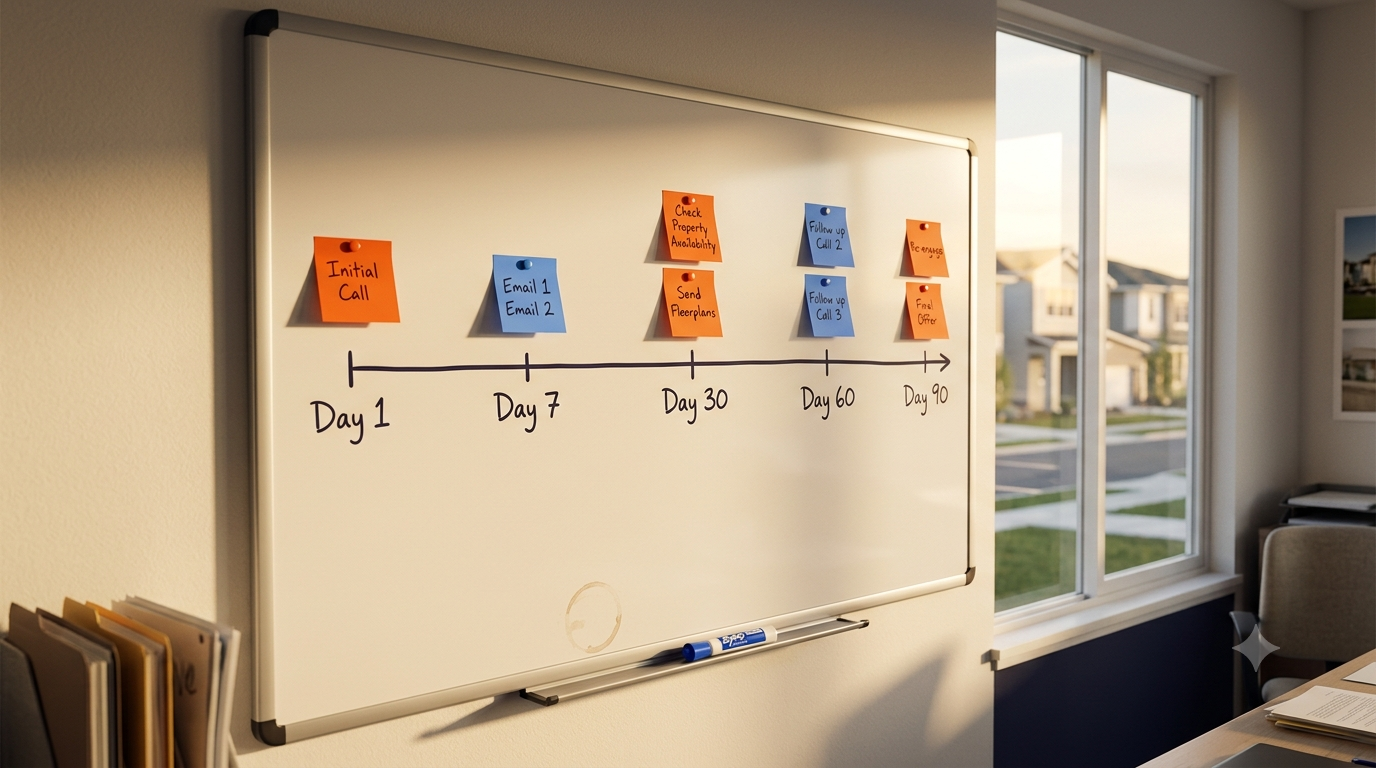
A cadence fixes the firework problem. Instead of dumping all your energy into the first two days and abandoning the buyer after, a 30-60-90 cadence spreads disciplined, relevant touches across the whole window where a new-home decision actually happens. Below is a template you can install this week. Adapt the messages to your communities and brand voice, but keep the rhythm — the rhythm is what keeps buyers warm until their timing turns real.
How to think about a new-home cadence
Three principles shape every good cadence, and they’re worth holding in mind as you read the template:
Front-load speed, then shift to value. The first touches are about speed — reaching the buyer while the inquiry is hot, which the Harvard Business Review lead-response research shows matters enormously. After the first week, the job changes from speed to staying useful: giving the buyer reasons to keep you in mind as their timeline approaches.
Every touch earns the next one. A touch that delivers something — a new quick-move-in listing, a financing update, an event invite, an answer — buys permission to reach out again. A touch that’s pure “just following up” spends goodwill and gets you muted. Relevance is what makes a long cadence feel like attention instead of pestering.
Multi-channel beats single-channel. Buyers answer different things at different moments. A cadence that mixes call, text, and email reaches people a single channel misses — just mind the texting-consent rules as you scale outbound messaging (CTIA’s messaging principles are the standard reference). We lay out the messaging mechanics in Home Builder Follow-Up Text Templates.
The template: a 90-day cadence for a new inquiry
This is the sequence for a fresh inquiry who hasn’t yet toured or declared a firm timeline. The moment a buyer engages — replies, books a tour, asks a real question — you break out of this baseline cadence and into a higher-touch sequence like the post-tour follow-up playbook. The cadence below is the floor, the thing that keeps a quiet buyer warm until they’re ready to step up.
Days 1–7: The speed phase (5 touches)
The hot window. The goal is simply to make contact and start a conversation.
- Day 1, within 5 minutes — call + text. “Hi Maria, this is Jenna with Saddle Creek — saw you were looking at the Magnolia plan. Is now a good time for a quick question or two?” Speed here is everything; the first five minutes outperform the first hour by a wide margin.
- Day 1, evening — email with the floor plan, community map, and a single clear next step (book a tour).
- Day 2 — text with a soft, specific question: “Were you hoping for single-story, or open to two-story plans too? I can send the best matches.”
- Day 4 — call at a different time of day than Day 1, plus a voicemail that gives a reason to call back.
- Day 7 — text with a light value-add: a new quick-move-in home, an upcoming model-home event, current incentives.
If the buyer engages anywhere in here, stop the cadence and switch to a real conversation. If they stay quiet, roll into the nurture phase — don’t quit.
Days 8–30: The early nurture phase (touches every 5–7 days)
The buyer didn’t bite in week one. That is not a no; most aren’t ready yet. Shift to spaced, value-led touches.
- ~Day 14 — email with something genuinely useful: a “how the buying process works” overview, a financing-options explainer, a community update.
- ~Day 21 — text tied to a real event or change: “New phase just released at Saddle Creek with a few single-story lots — want me to send them before they go?”
- ~Day 30 — call to re-offer a no-pressure tour, framed around what’s new since they inquired.
Days 31–60: The mid nurture phase (touches every ~10 days)
Cadence stretches; relevance tightens. Every touch should carry news or value.
- ~Day 40 — email: a quick-move-in roundup or a price/incentive update.
- ~Day 50 — text: a check-in anchored to their original interest. “Still thinking about a move this year? The Magnolia’s been popular — happy to hold a tour slot whenever timing’s right.”
Days 61–90: The long nurture phase (touches every ~2 weeks)
You’re now playing the timing game. The buyer who’s six months out is approaching their window. Stay present without crowding.
- ~Day 70 — email: a community milestone, a model-home event invite, a seasonal update.
- ~Day 85 — call + text: a warm, low-key “are we getting closer to the right time?” that makes it effortless to re-engage.
After Day 90, a buyer who’s still silent moves to a light, ongoing nurture and gets re-scored the moment they re-engage — exactly the signal we prioritize in Which Aged Leads Should You Call First?. They don’t fall off a cliff into the dead pile; they stay warm on a low flame.
Why cadences die in the real world
Read that cadence and the failure mode is obvious. It’s a multi-channel sequence of a dozen-plus precisely-timed touches, per inquiry, sustained over three months — and your OSC is starting fifty new inquiries a month while running the floor. Nobody executes a 90-day, multi-touch cadence by hand for fifty buyers a month on top of a full sales role. So the cadence that exists on the whiteboard becomes, in practice, the firework again: a couple of touches in week one, then silence. The long tail of the cadence — the Day 30, 50, 85 touches that catch buyers right as their timing turns — is exactly the part that never gets sent, and it’s the part with the highest payoff.
This is the structural reason follow-up fails almost everywhere in new home sales: the process is knowable and the human capacity to run it consistently isn’t there. It’s the same root cause behind tours that don’t convert and “leads” that were really just abandoned — see Stop Blaming Lead Quality.
Make the cadence a property of the system, not the person
The whole point of a cadence is consistency, and consistency is precisely what a busy human can’t guarantee — so don’t ask one to. Jome makes follow-up a property of the system, not the person. Jome runs the full cadence automatically for every inquiry: the five-minute first touch, the spaced nurture, the long-tail check-ins at Day 30, 50, and 85 — across voice and text, in your brand’s voice, referencing the buyer’s plan and community. When a buyer engages at any point, Jome holds the conversation, qualifies them, and books the ready ones onto your OSC’s calendar, breaking out of the baseline cadence into a real sales conversation. Your reps stop being responsible for remembering to send Day 50’s text to four hundred different buyers — and the long tail of the cadence, the most valuable and most-skipped part, finally runs every time.
If you’re weighing whether to build this engine yourself or buy it, our build vs buy guide walks through the trade-offs.
How to measure whether your cadence is working
Touch completion rate — of the touches your cadence specifies, what share actually get sent? At most builders, honestly measured, it cliffs after week one. This is the number automation moves most.
Re-engagement rate by cadence phase — what share of buyers reply or book during the Day 8–30, 31–60, and 61–90 windows? A healthy cadence produces a steady trickle of re-engagements deep into the timeline, not just in week one.
Time-to-tour from inquiry — how long from first inquiry to first tour? A real cadence shortens it for buyers who were ready and extends your reach to buyers who needed weeks, both of which show up as more tours on the board.
FAQ
What’s the difference between a sales cadence and a drip campaign? A drip campaign is usually a fixed series of automated emails that fire regardless of behavior. A cadence is multi-channel — call, text, email — and responsive: it changes based on what the buyer does, and a real person (or a capable AI) can step into a live conversation the moment the buyer engages. Cadences convert better because they’re conversations, not broadcasts.
Isn’t a 90-day cadence too long? For new homes, 90 days is often too short. Many buyers are six to twelve months out. The cadence above is a floor; the principle — spaced, relevant touches that stretch as the timeline lengthens — extends well past 90 days. The mistake almost no builder makes is following up too long. They quit far too early.
How do I keep a long cadence from feeling like spam? Make every touch carry value — news, an answer, an invite, a relevant listing — and space them out as the timeline lengthens. Spam is repetitive and self-serving; good cadence is helpful and buyer-centered. If a planned touch has nothing to say, skip it rather than send filler.
Can I run this in my CRM? A CRM can schedule reminders and send drip emails, which covers the easy part. What it generally can’t do is place the calls, send personalized texts referencing the buyer’s specific plan, and hold a real conversation when the buyer replies on Day 47 — that conversational layer is what actually converts the cadence, and it usually has to sit on top of the CRM.
A cadence on a whiteboard converts nothing
The builders who win the long timeline aren’t the ones with the cleverest first-day pitch. They’re the ones still showing up — usefully — on Day 50, when the buyer’s house finally sells and they’re suddenly ready to move. Design your cadence, write the touches in your brand’s voice, and then make sure something actually runs all of them, for every inquiry, all the way down the tail.
If you want to see your own touch-completion rate by cadence phase — and what it looks like when every touch fires automatically — book a 20-minute walkthrough with Jome. We’ll show you where your cadence is quietly going dark and how much pipeline is waiting in the part you’re not reaching.
Put this cadence on autopilot across every lead — see how Jome runs it at ai.jome.com.