Calls Made Is a Vanity Metric in New Home Sales | Jome
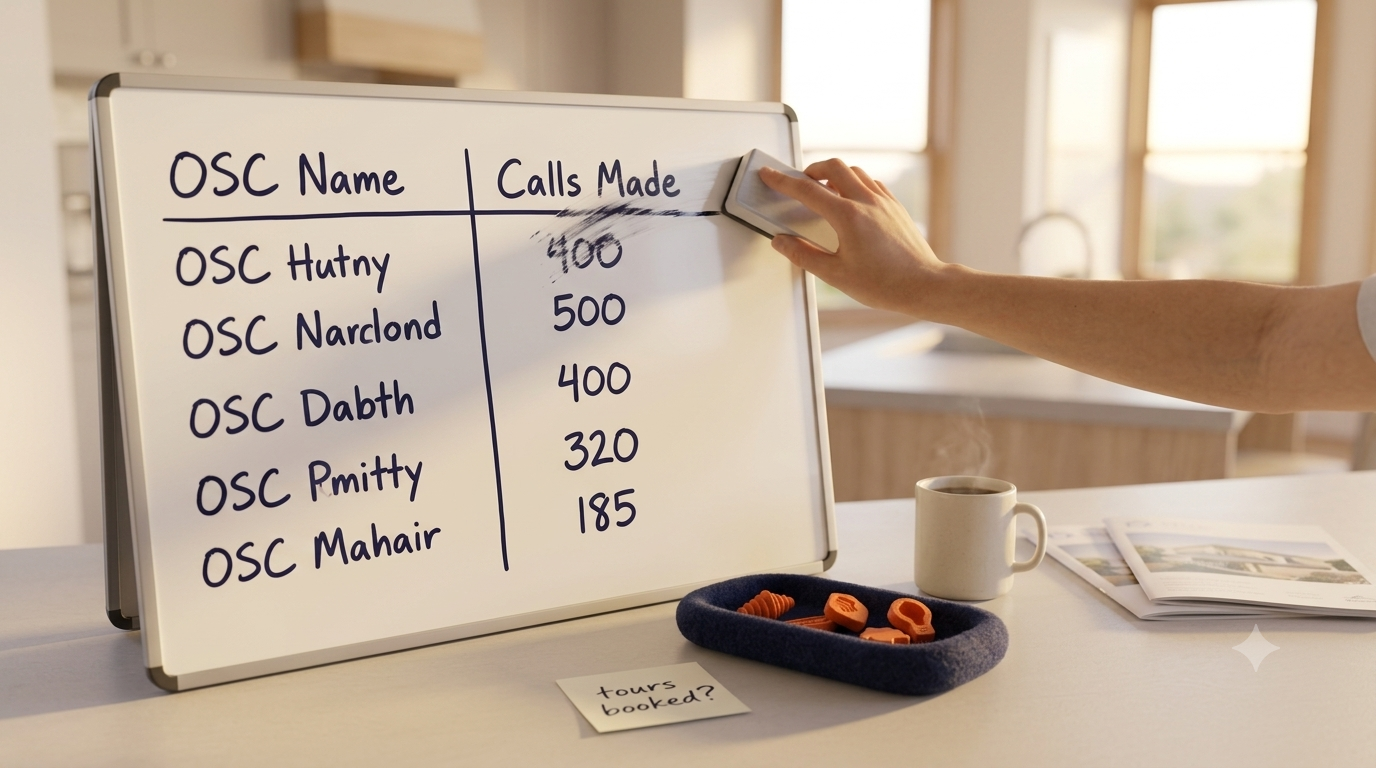
Walk into most home builder sales offices and you’ll find a leaderboard counting calls made, texts sent, or “touches” logged. It feels like accountability. It looks like rigor. And it is quietly steering your best people toward exactly the wrong behavior.
I’ll say the uncomfortable part plainly: “calls made” is a vanity metric. It measures how busy your OSCs are, not how effective they are — and in new home sales, those two things come apart fast. A rep can make eighty calls in a day, book zero tours, and top the leaderboard. Another rep can make twenty calls, book four tours, and look like they’re slacking. Your dashboard is rewarding the wrong one.
What makes a metric a vanity metric
A vanity metric is one that’s easy to grow, feels good to watch go up, and doesn’t connect to the outcome you actually care about. The sales analytics world has been clear on this for years — as the Gong analysis of sales metrics puts it, counting activities encourages volume over quality, and the metrics worth tracking are the ones tied to conversion and revenue, not motion. The definition of a vanity metric is exactly that: a number that’s easy to grow and gratifying to watch but masks the things you should actually be fixing — lead quality, conversion, retention.
“Calls made” checks every vanity box. It’s trivial to inflate (dial and hang up, log a “touch”), it’s satisfying to rank, and it tells you nothing about whether a single buyer is closer to a tour. Worse, when you put it on a leaderboard, you don’t just measure the wrong thing — you cause the wrong thing. Reps optimize for the number you celebrate. Celebrate dials, and you’ll get dials: fast, shallow, box-checking calls that burn through your lead list without advancing anyone.
The four ways activity metrics distort a sales team
They reward speed-through, not speed-to. There’s a world of difference between responding to a new inquiry in five minutes (which wins tours — see Speed to Lead for Home Builders) and racing through a call list to pad a number. Activity metrics can’t tell them apart, so they reward the wrong speed.
They punish patience on the leads that need it. A buyer who’s six months out needs a couple of thoughtful, well-spaced touches, not eight calls this week. An OSC chasing a “touches” target will over-contact that buyer into a “STOP,” because the metric demands volume the relationship doesn’t.
They hide the leads going untouched. A team can post huge activity numbers while an entire segment — the aged database, the after-hours inquiries — never gets worked at all, because nobody gets leaderboard credit for it. We dig into that buried opportunity in Database Reactivation for Home Builders.
They make burnout look like performance. The rep grinding out a hundred dials a day is “winning” right up until they quit. Activity metrics applaud exactly the unsustainable behavior that empties your sales floor.
The metrics that actually predict pipeline
Here’s what to put on the board instead — outcome and efficiency metrics that connect to tours and closings, not motion.
Speed to first contact (median, by hour of day). Time from inquiry to first real touch, tracked as a median so a few fast responses don’t hide a slow tail. Split business-hours from after-hours; the after-hours number is usually where your pipeline is leaking.
Lead-to-tour conversion rate. Of the inquiries an OSC works, what share become a booked, shown tour? This is the number that ties follow-up effort to revenue, and it rewards the rep who books four tours from twenty calls over the one who books none from eighty.
Tour show rate. Booked tours are worthless if buyers don’t walk through the door. Tracking show rate surfaces the no-show problem you can actually fix with a confirmation sequence — How to Reduce Model Home Tour No-Shows.
Database coverage rate. What percentage of your total addressable leads — including the dormant ones — actually got a meaningful touch this period? This is the metric that catches the leads silently rotting in your CRM, the ones no activity leaderboard ever surfaces.
Speed-to-tour-booked. Time from inquiry to a confirmed appointment on the calendar. It compresses your whole top-of-funnel into one revenue-linked number.
Notice the pattern: none of these can be gamed by dialing and hanging up. Every one of them only moves when a buyer actually gets closer to buying a home. That’s the test of a real metric.
“But activity is the only thing reps control”
The honest objection to all this is real: outcomes depend on lead quality, market conditions, and a dozen things an OSC can’t control, while activity is the one thing they can. That’s why activity got measured in the first place.
But the answer isn’t to measure motion — it’s to measure the controllable outcomes. Speed to first contact is almost entirely within your control. Show rate is controllable with a confirmation sequence. Database coverage is controllable by deciding to work the whole list. These reward the right behavior without collapsing into “just be busy.” You can hold reps accountable for the things they control without paying them to look busy.
Remove the busywork the vanity metrics were measuring
Here’s the deeper move, and it’s the one that makes the metric question almost disappear. The reason “calls made” got onto the board is that the follow-up grind is enormous and someone has to be seen doing it. But most of that grind — the instant first reply, the day-before reminder, the after-hours text, the fifth touch on an aged lead — is exactly the repetitive, time-sensitive work that doesn’t need a human and that no human can do consistently at volume anyway.
This is where AI extends your team. When an AI layer guarantees the time-sensitive, repetitive follow-up fires for every lead — instantly, persistently, on brand — your OSCs stop needing a “calls made” target to prove they’re working, because they’re no longer the ones grinding through the list. They’re spending their hours with the buyers who are ready to talk and tour. The leaderboard can finally measure what matters — tours booked, tours shown, deals closed — because the busywork that “calls made” was standing in for is handled by the system. You stop measuring activity because you stopped needing your people to do the activity.
If you want the fuller argument for what stays human and what doesn’t, Will AI Replace Your OSC? lays it out honestly, and the staffing-model comparison is in AI Voice Agent vs Inside Sales vs Call Center. For deciding whether to build that layer or buy it, see Build vs Buy AI Lead Follow-Up.
FAQ
Should I stop tracking activity entirely? Track it for diagnosis, not for performance. Activity data is useful for spotting a rep who’s gone quiet or a process that’s broken — just don’t put it on the leaderboard, because whatever you rank, you incentivize.
What’s the single best metric to start with? Median speed to first contact, split by hour of day. It’s controllable, it’s tightly linked to booked tours, and the after-hours slice usually reveals your biggest, cheapest win.
Won’t my reps push back on outcome metrics they don’t fully control? Some will, and the fix is to choose controllable outcomes — response speed, show rate, coverage — rather than raw closings. Pair the new metrics with removing the busywork, and the pushback fades, because you’re not asking them to do more; you’re freeing them to do the part that counts.
How does this connect to capacity? Directly. Most builders feel understaffed because their OSCs are buried in follow-up busywork — the same busywork vanity metrics reward. Fix the metrics and offload the grind, and existing capacity stretches further, as we argue in The Understaffed OSC Problem.
Measure the sale, not the motion
Your OSCs will give you exactly what you put on the board. Put up “calls made,” and you’ll get a busy, burning-out team and a lead list churned through without being worked. Put up speed-to-contact, conversion, show rate, and coverage, and you’ll get the behavior those numbers require — which happens to be the behavior that books tours and sells homes.
Want to see your follow-up measured by outcomes instead of activity — and the busywork that “calls made” was hiding handled automatically? Book a 20-minute walkthrough with Jome. We’ll look at your real speed-to-contact and coverage numbers and show you what’s been hiding behind the activity totals.
Track the metrics that actually move contracts — see Jome's dashboard at ai.jome.com.